As President Lee calls for a review of preferential treatment, marriage migrants describe limited support and warn of a backlash against their families

For some marriage migrants in Korea, President Lee Jae Myung’s recent warnings about excessive benefits for multicultural families bear little resemblance to the lives they have led.
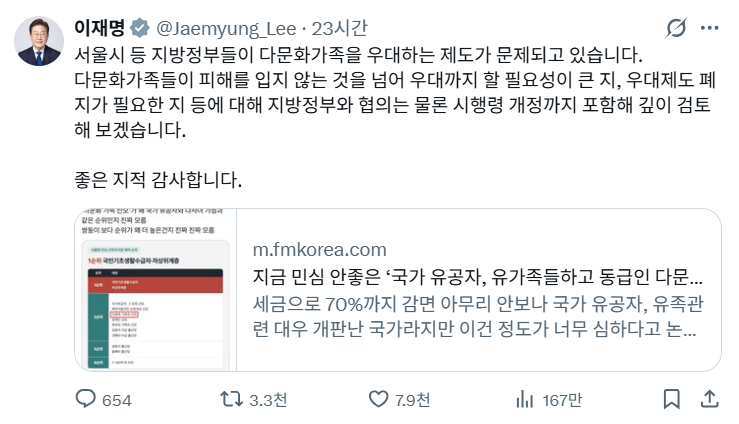
Lee has posted several messages on X since Wednesday questioning whether certain benefits for such families go too far.
Members of such families and their advocates say the debate risks obscuring the difficulties they continue to face while fueling hostility toward migrants.
“Even after raising my children until they were old enough to enter college, I have not felt that we received anything beyond the general government support available based on income,” said a woman surnamed Li from China who came to Korea 20 years ago after marrying a Korean man.
“Multicultural women around me who have young children mostly benefit from things like free classes for their children at multicultural centers on weekends. It feels bewildering and unfair to hear some policies described as ‘excessive preferential treatment.’”
Multicultural families generally refer to households formed by a Korean national and a person from a different cultural background.
Calls to review preferential treatment
The controversy began Wednesday when Lee wrote a post on X questioning preferential treatment for multicultural families, citing admission priorities under Seoul’s subsidized postpartum care program.
The program operates through participating private postpartum care centers. Mothers from multicultural families receive second-priority admission alongside groups including mothers with disabilities, North Korean defectors and national merit recipients or their family members.
Recipients of basic livelihood benefits and people in the near-poverty category receive first priority.
“(We will) thoroughly review, in consultation with local governments and even through amendments to enforcement decrees, whether there is a compelling need to go beyond preventing harm to multicultural families and grant them preferential treatment, and whether the preferential treatment system should be abolished,” Lee wrote.
On Thursday, he reiterated that some policies should not stray from their original purpose and become excessive benefits or reverse discrimination.
He stressed that his remarks were aimed at correcting excesses in certain policies and should not be interpreted as promoting discrimination or hatred.
The presidential office said Thursday that it would seek to revise the Enforcement Decree of the Mother and Child Health Act to ensure that postpartum care benefits go first to mothers who need them most.
Beyond the benefits debate
Immigrant rights advocates and marriage migrants have questioned Lee’s remarks, saying that the benefits available to multicultural families are limited.
“In the case of the public postpartum care centers at the heart of this controversy, I think the priority was set with consideration for the fact that migrant women often have no relatives, friends or neighbors who can help them after childbirth,” said Wang Ji-youn, who works with a migrant women’s organization in Seoul.
“Many multicultural families are already in the near-poor or public assistance recipient categories, which often makes them eligible for priority support,” she added.
Immigrant rights advocates also worry that the debate could fuel broader hostility toward foreign nationals in Korea.
One of Lee's X posts quoted another post on FM Korea, an anonymous community board, that criticized not only preferential treatment for multicultural families under Seoul’s subsidized postpartum care program but also broader policies to support foreigners and encourage them to settle in Korea.
“Much of the support for multicultural families in Korea is, in effect, aimed at helping them raise children who are Korean nationals or care for their Korean parents,” said Lee Han-sook, director of the Migrant Human Rights Institute.
She added that it was concerning to see even support for raising Korean children and caring for Korean parents come under criticism as the population with immigrant backgrounds grows.
“It is problematic to make such remarks without examining the circumstances in detail, as it can create the impression that multicultural families receive substantial preferential treatment,” she said.
Gaps in support
Members of multicultural families who spoke with The Korea Herald called for more targeted and effective support, while acknowledging that their Korean neighbors also face economic and other difficulties.
“To judge whether support for migrants is excessive, it would be helpful to first disclose detailed statistics and how the programs are implemented, and to listen to the voices of people directly affected,” Li, the woman from China, said.
A Vietnamese woman married to a Korean man and living in Suwon, Gyeonggi Province, also called for greater consideration of the difficulties migrants face as they navigate life in an unfamiliar country and language.
“In fact, many families even find it difficult to access support that requires paperwork. My husband speaks Korean but goes to work, and I do not speak Korean well. I also work,” she said.
Advocates say support should go beyond the current framework for multicultural families and help a broader range of foreign residents adjust to life in Korea, as the foreign population grows.
“Local governments’ proactive support largely targets multicultural families consisting of a Korean spouse and a foreign spouse. Families consisting of two foreign nationals are not covered at all,” Park Jung-hyung, an official at the Korea Migrant Human Rights Center, said, referring to the scope of multicultural family support programs.
“The difficulties parents face become part of the world their children experience, affecting various aspects of their lives, including their ability to communicate in Korean society. These actual difficulties need to be taken into account.”
forestjs@heraldcorp.com